

What the Creek Carries
By Staci Mercado
On family farmland, vanishing margins, and learning what it means to love a place well.
I learned to love a farm before I understood what it asked of the land.
Mom and her two sisters inherited a 160-acre farm north of Welton, Iowa, where they had grown up. Before my grandparents retired, they grew corn and soybeans; raised cattle, hogs, and chickens; and kept dairy cows.
The girls’ work began before school and continued after the last bell. They gathered and washed eggs, fed cattle, drove the hay fork and baler, walked the bean fields pulling volunteer corn, and dug thistles from the pasture. The farm asked for their hands in every season, and they gave them.


My grandparents, Thelda and Stanley Kaszinski, with their daughters. Janet (the eldest), Mary, and Patricia (the youngest).
Years later, Mom and Dad raised my younger sister, Sara, and me in the large, square farmhouse surrounded by nine outbuildings—mostly empty, and mostly retired. While the three sisters made many decisions about the land together, Aunt Janet and Uncle Tom physically farmed the place, planting a rotation of corn and soybeans with equipment housed at their home place up north.
Other than the fields themselves, the only sign of a working farm was the newly constructed steel grain bin, whirring in fall with its drying breath. Around it stood the architecture of my grandparents’ more varied farm—the barn, chicken house, hog shed, cattle shed, corn crib, silo, and milkshed—a museum of bygone days. The land’s working rhythm had narrowed to corn and soybeans, though I did not yet understand what had been lost—or what had made that narrowing seem inevitable.
Once the center of activity, the quiet barn housed an old blue car and families of raccoons and opossums. Sara and I mostly steered clear of it. The barn felt too wild somehow, too full of scary potential: broken limbs, rabid animals, or other fevered threats born of our imaginations.

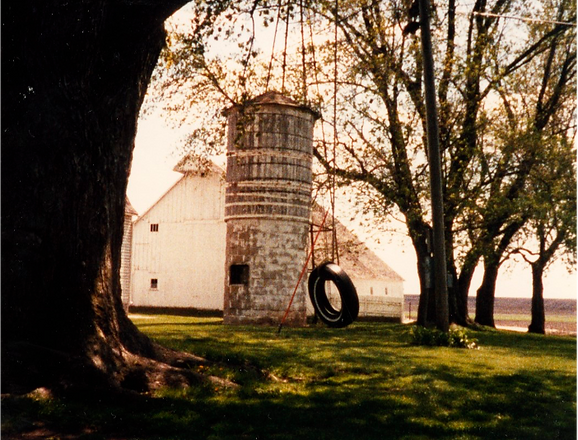
The farm in the 1980s.

Mom wrote volumes on the machine shed walls as a kid.
The walls of the machine shed were filled with words. As a young girl, Mom had written volumes in perfect cursive to pass the time. One old photograph clearly captures the word Jesus. By then, the shed housed only two machines: the lawn mower and Dad’s old John Deere tractor, useful for plowing the long lane when Dad’s routine of cussing a blue streak succeeded in coaxing the motor to life.
At the first sign of tractor-induced language, Sara and I headed for the old chicken house to play with the cats. We had affectionately named the building the cat house, unaware of the phrase’s other connotation.
Mama Cat, a gnarly, hardened old girl who had lost a leg in a trap, raised dozens of kittens inside the old rooster pen. We kept it padded with straw for her comfort.
Sara and I set up rooms and played house in the old hog shed. The concrete floors had long been cleaned of manure, and no scent of hogs remained in the old wooden slats between the pens.
We swung from a rope in the dusty haymow of the cattle shed and imagined Grandpa Stanley tending the cows in his OshKosh bib overalls.
The little silo shed offered a breezy view to the top of the silo. Occasionally, a family of raccoons peered back at us from its heights. Their droppings mingled with mold-blackened corn crusted at the bottom.
The milkshed and the barn.
The old round milkshed, once used to keep milk cool and clean, was difficult to enter because its wooden door hung partially off its hinges. But once inside, Sara and I wondered over the dairy equipment, relics of days gone by. An oval milk trough sat inside. When Mom was a kid, the flip of a switch activated the windmill, which filled the overhead tank with cool water to keep the milk fresh. The local creamery picked up the milk and left butter behind. Mom was often caught with her young fingers in it. Though the milkshed was long past its usefulness, Dad clambered onto its precarious roof to repair the shingles and protect the memory of those working days.
Though Grandpa had passed, and his farming years were long before we moved in, his old tin cup still hung from a hook at the windmill, ready for a cool drink from the well. Daring souls were known to climb into the windmill’s upper reaches during evening bouts of hide-and-seek. The daring usually won.
Inside the house, Grandma Thelda made thirteen loaves of bread every Monday. When the girls got off the bus, they could smell it before they reached the house and raced inside, each hoping to be first in line for a warm piece. Grandpa Stanley loved that bread, too. They ate it thick with fresh butter.
Grandma also kept a garden, canning or freezing whatever the season gave her. The girls were expected to help.
Mom kept a large garden when Sara and I lived there, and we inherited both its abundance and its obligations. We grumbled when Mom called up the stairs to wake us for garden chores. I disliked picking strawberries and searching for elusive beans tangled in foliage. If I moved too lazily through a row, Mom made me start again.
When swept clear of old corn, the smooth floor of the corn crib made a decent skating rink, provided we avoided the unloading trench in the ground. The separate garage had a staircase in back, and its upper floor was filled with belongings from my grandparents and from my aunt and uncle, who had lived there for a time before we did.


Our dog, Copper, was our constant companion. In the first photo, she’s a young pup just in front of the tree. In the second, she’s older, standing with my sister Sara and me atop the snowdrifts.
The lane’s ninety-degree angle collected snow like nowhere else. Big snows meant big snow forts, and Dad knew just where to place the piles for maximum play potential. Sara and I dug into them like the cabin-fevered children we were, building a full floor plan with two bedrooms and, of course, a kitchen, where we squirreled away snacks in a snow hole.


Sara on a swing beneath the pines; me on one of our old three-wheelers; and the two of us running with the kitties.
Weaving around all this was a meticulously mowed expanse of bluegrass, where we played softball, threw snowballs, and generally ran around. Mom and her sisters had played there, too. Beneath an enormous lilac bush, they made “the house,” a natural space of branches and leaves big enough to hold their games. They turned cartwheels, played ball, and chased one another across the yard, making the same kind of childhood that Sara and I would inherit years later.


My immediate family circa 1989 and Uncle Tom and Aunt Janet at Sara’s birthday party.
Both moments were captured in the farmhouse kitchen.
Anyone on mowing duty had to devote four or five hours to pushing and riding—a mindless, somewhat meditative job, unless one was listening to ’80s hair bands. Then one might try out her singing voice, since the closest neighbor was half a mile away. Dad usually lit a cigar or, in the fall, picked an apple straight from the trees.

Planted in the 1880s, the maple tree behind the house measured more than 25 feet around its trunk.
Just outside the back porch stood an enormous maple, more than twenty-five feet around, its trunk formed around a metal pole that had marked the fence line enclosing the yard when Mom was little. Over the years, the tree had grown around the pole and taken the old boundary into itself.
Planted by the original inhabitants of the house in the 1880s, the maple was a wonder. She had seen more of life on the farm than any of us and deserved a say in its goings-on.
When Aunt Mary’s husband, Al, poured a patio for us, he had to cut through some of the maple’s roots to lay the concrete. Years later, a large limb of the old tree fell and shattered the back window of their car. Al always said the maple was getting revenge.
Most of the trees at the farm were ancient compared with us, and they sheltered all manner of creatures. My favorite was the great horned owl that roosted in the pines just outside my bedroom window. When I heard him call, I often whispered for Mom to join me. Many nights, we stood in my darkened bedroom and listened to the wisdom of that owl.

A great horned owl roosted in the pine trees north of the house.
Near our modest orchard, a stretch of elm trees ran along the gravel road. Beneath them, tall grasses were allowed their space. If Mom needed help in the house, her voice frequently found me nestled among those grasses with a Walter Farley novel. I was horse-crazy, but Mom and Dad had made it clear that I would need to be content with my imagination.
Near the long lane, another patch of grass grew wild. Wild grass makes room for other wild things—snakes, for instance. Dad was terrified of them. While Mom and I sacrificed neatly mowed rows to save one, Dad had the opposite instinct: he steered toward them, hoping there might be one less snake in the world. If he was mowing, Mom, Sara, and I walked the area first to rescue any slitherers. Occasionally, we chased Dad with a garter snake in hand. He moved pretty fast for an “old” guy.
Some members of nature are harder to love, though, even for me. Take skunks. Dad had been sprayed by one once, resulting in weeks of tomato-juice baths and sulking. He passed his fear of getting skunked on to us girls, which resulted in my sister being left in the dust more than once when a potential skunk appeared. I fended for myself. Sorry, Sara.
Like all of Iowa’s natives, skunks play an important role in a healthy ecosystem, but this logic was lost on us.


Copper and Grandpa Stanley and the girls with Shep.
Somewhere on the clipped lawn, Copper, our sweet red-haired mutt, would have dragged a stillborn piglet hauled up from the neighbors' farm. Copper survived at least two encounters with a barbed-wire fence and knew how to defend her dog bowl from hungry raccoons. She and Dad bonded over their confrontations with skunks. She mostly got along with the cats, but if a car came up the drive, she chased the nearest cat beneath a worn hole in the shed door, just to show off.
She was, of course, the best dog ever.
Grandpa Stanley had a succession of dogs, and he trained them to keep watch at the cattle gates. One afternoon, as Mom and her sisters got off the bus, Shep was not there to greet them. When Grandpa came out of the barn without the dog at his side, they asked where she was. Only then did Grandpa realize he had forgotten her at the Welton gate, where she had been on watch all day.
He tore off in his truck and found Shep dutifully at her station: hot, thirsty, and tired. She would have done it all again if Grandpa had asked.
She was, of course, the best dog ever.
After the fields were harvested, I’d traipse through the rows in search of ingredients for my fall “stew”: handfuls of corn and beans left behind in the field, along with unharvested produce from Mom’s garden. There were usually a few gnarly tomatoes and soggy potatoes unfit for family consumption but perfect for play.
I added water to my concoction, filling a five-gallon pail nearly to the brim, then stirred the mess with a broom handle. I remember pretending many things. In one version, I was a witch, and the stew was meant for an unsuspecting soul in need of something—a lesson, perhaps. In another, my family could actually eat what I was making.
If not for the dirty bucket, that second fantasy seemed almost plausible—until I learned that the corn and beans, which made up most of the ingredients, were not exactly edible for human beings.
“What do you mean, we don’t eat it?” I asked Mom as we headed into town for groceries. We drove past twelve straight miles of corn and beans, and people didn’t eat any of it?


Preparing sweet corn for the freezer—and eating some along the way—was a yearly tradition. We processed large batches in the basement kitchen. A cousin and Mom eating corn on the back steps. Sara tackling an ear of corn despite a few missing baby teeth, and Aunt Janet and me.
Mom explained the difference between sweet corn—mouthwateringly edible, especially slathered with butter, salt, and pepper, the kind we froze in large batches—and field corn, used to feed livestock, make ethanol, and as an ingredient in processed foods we probably shouldn’t be eating.
Despite all the wonder and possibility near the house, my favorite place on the farm was the creek beyond the closest field. Our family farmed acres on both sides of it, so that stretch of water felt like ours.
Two bridges crossed the creek. One was simply a rock bridge. Grandpa used to take me for country rides in his red truck, and no trip was complete without a bumpy, laughter-filled crossing there.
Farther down was a concrete bridge for farm equipment. Between the two bridges, engulfed in tall grasses, a six-foot-wide slab of concrete shaped like a couch faced the creek. Mom showed it to us shortly after we moved in. It had been her hideaway many years before. You can guess where I spent most of my time.
That was where I wrote in my diary, ate cookies snuck from the kitchen, and tried my first cigarette. Copper was usually nearby. The tall grass swallowed her, but I could always tell where she was by the way it moved: a ripple through the stems, the rustle of her paws, a flicker of red. She was forever out there hunting for something interesting.

Many species of goldenrod grew with the tall grasses near the creek.
A good thirty-foot stretch on either side of the creek remained untouched by the plow. Native grasses and flowers housed myriad creatures worth investigating: yellow garden spiders, black swallowtails, wily bull snakes, and many more.
Near the property line, where our farmland met the neighbors’, the creek forked, creating a much wider wild area than anywhere else along its course. Grasses, flowers, and wild things inhabited more space there. Crossing the creek by way of the tiny island between the forks led to wet shoes, wet pants, and, if one was particularly clumsy, more than wet pants.
Heaven is a patch of grass so wide and tall that you cannot see signs of human habitation. I did not know much about ecology then, but it took little more than a child’s observation to recognize how much more life flourished in and around the creek. Muskrats, songbirds, deer, and countless insects called that land home.
Though barbed wire was dangerous to Copper, who snagged her inner thigh more than once on its rusty points, the tall grasses along the fencerows were a haven for living things that were not corn or beans. Those long, narrow strips—tight margins marking ownership—were home to many creatures. Foxes denned and raised kits. Coyotes ran wild. Pheasants roosted. One year, the neighbor spotted a badger.


Grandpa on the Farmall tractor with Mary's son, Larry, on his own mini version. Grandpa Stanley and Grandma Thelda on their 25th wedding anniversary in 1965.
Spring and fall were always my favorite times of year. Aunt Janet and Uncle Tom came for the work of planting and harvesting, while Mom and Aunt Mary made a hearty spread for dinner. There was much laughter as the family reminisced about the old days.
Beyond the meals, Sara and I participated in planting and harvesting by riding along with Aunt Janet in the tractor or Uncle Tom in the combine. Janet was a talker—sassy, curious, and never short on questions or opinions. From her, I learned more than the rhythms of planting and harvest. She taught me how to drive, how to make homemade cinnamon rolls, and, perhaps most importantly, how to stand up for myself.
Uncle Tom was quieter, but he was a good sport. He loved a good chuckle and a good book, and he let Sara and me ride beside him as the combine took in row after row of corn. The whole production fascinated me: the machinery, the disappearing rows, the adults who seemed to know how to keep everything moving. In my youth, I romanticized farming until it seemed the noblest profession in the world. Why did anyone need to go to school when all this real life was happening?
Life on the farm was the only life that made sense. Even walking acres of beans to pull weeds on a hot summer day seemed preferable to the horrors of seventh grade. I tried to make sense of nonsensical teenagers—the most nonsensical of them being myself—but I did not know who I was unless I was home.

One afternoon in the late 1980s, after a dreadful day at junior high, I desperately needed to be outside. I don't remember what happened at school. Honestly, I have blocked most of it from my mind. But I remember what happened afterward.
I stepped off the hot bus, changed into my old knock-around clothes, and headed for the creek. I knew something was wrong long before I reached the water. The air smelled of violated earth, ripped off its hinges.
An old newspaper advertisement shows the corn crib.
Instead of birds flying overhead, crickets and katydids nesting in the tall grasses, and butterflies, bees, and other pollinators filling the air, the land was quiet—less alive, and much less beautiful.
The grass along the creek had been reduced to a nub. Standing at the edge of the freshly tilled soil, I could have leaned forward and hung my head over the creek bed. I jogged the length of our property, hoping there might be some stretch of wild left behind, but almost all of it was gone. My uncle had even plowed closer to the fork on the east side of the property, where the wild area had once widened.
I sat on the old concrete couch, the only remaining place where a wider stretch of grass had been allowed to stay, and only for obvious reasons.
As any young ecologist knows, less native land means less food and habitat for the natives. I sank down into that uncomfortable couch, and I cried.
When I was done crying, I marched up to the house. Though Uncle Tom farmed the land, I knew some decisions were made collectively. I could not shout at him; he had already gone home. So I barreled in the back porch door and shouted at my poor mother.
“Why?”
“Why what?”

The shallow root systems of corn are not suited to hold back stream bank erosion.
“Why did he plow it all under?”
Mom’s hands were busy making dinner. “I don’t know anything about it,” she said.
And she didn’t. At the time, the pressure to farm every last inch was strong. Part of the pressure my uncle felt was economic. Part of it was social. It was simply the way things were done.
Farming to the very edge of a creek leaves little room for the creek to protect itself—or for the rest of the living world to remain there.
A fringe of grass, flowers, shrubs, and trees can hold a creek’s edge together. Its roots clutch the soil when rain comes hard; its stems slow the water and catch some of what the fields let loose before it reaches the creek. In that ragged space there is shade and cover, food and nesting places, room for a fox, a monarch, and a child with a book. Without it, the plow takes more than a few additional feet. It changes what the creek carries, what the soil keeps, and who gets to live there.
It was the first time I questioned this way of life—or, more precisely, a particular way of doing things.
I did not yet have the language for riparian buffers, nutrient runoff, habitat fragmentation, or the economic pressures that make every tillable inch seem too valuable to leave alone. I only knew that the grass was gone. The spiders, butterflies, snakes, and songbirds had lost a place to feed, hide, hunt, nest, and raise their young. The creek, once protected by a wide, natural margin of life, now lay exposed beside the crop rows.

Native plants help filter runoff and provide habitat for wildlife.

I understood something else, too: what had happened was not inevitable. It was a choice—one I later learned was shaped by money, social pressure, and the narrow definition of productivity that had come to govern so much of Iowa’s agricultural landscape.
Writer and farmer Wendell Berry died this September. His poems “The Peace of Wild Things” and “A Poem on Hope” have long been among my favorites. In their lines, I sensed a kindred soul: someone who understood that despair about the future can begin in a particular place, and that hope must begin there, too.
In “A Poem on Hope,” Berry writes, “Be still and listen to the voices that belong to the stream banks and the trees and the open fields.” For much of my childhood, I listened without knowing I was listening. I knew the creek by its muddy crossings and the feel of wet shoes. I knew the tall grass by the way it concealed me with a book. I knew the farm by the old barn, the cat house, the windmill cup, the creak of the milkshed door, Dad cussing the old tractor to life, and a family gathered around the table after planting or harvesting.


In our yard, native flowers offer nectar and pollen—and the pollinators remind us why we planted them.
But belonging to a place means more than loving what it has given you. It means learning to see what it needs from you in return.
Berry spent his life insisting that good agriculture must be rooted in care for land, water, community, and the generations to come. He did not imagine farming and nature as opposing forces. He asked readers to reject the false choice between feeding people and sustaining the places that feed them. Berry’s work repeatedly connects the health of farms and rural communities to the health of soil, water, woodlands, and the wider living landscape.
That is the work before Iowa now. Agriculture will remain part of this state’s identity, economy, and landscape. The question is not whether we will farm, but how. Will we treat a creek bank as wasted ground, or as a living boundary that protects water, soil, wildlife, and the people downstream? Will we measure a farm’s worth only in acres planted and bushels harvested, or also in the return of meadowlarks and pollinators, in cleaner water, in soil that stays where it belongs, and in a landscape resilient enough to be passed forward?
What we leave behind is written into the places we love. It is written in a child’s small hands gathering ingredients for an imagined meal; in a girl crying on a concrete couch beside a creek after the tall grass is gone; and in every child still ahead of us, who deserves more than corn and soybeans at the water’s edge. They deserve black swallowtails lifting from the flowers, katydids calling in the heat, a garter snake slipping through the grass, and enough wildness to make the human world seem far away.
Berry wrote, “Find your hope, then, on the ground under your feet.” I hear that now as an instruction to care for the ground I actually inhabit.
On our acre, my family and I are still learning what that means. We mow bluegrass because we live among neighbors, but we make room for native flowers and grasses, too—for pollinators, for birds, for the small wild lives that need more than a tidy edge. It is not the creek of my childhood, and it does not erase what was lost there. But it is a place where I can practice paying attention: where I can choose, again and again, to leave a little more room for life other than my own.
Staci Mercado won a Midwest Book Award for her historical fiction novel, Seeking Signs (Four Feathers Press, 2013). She has published work in Hippocampus, Broad Street, Barely South Review, Flash Fiction Magazine, Fiction Southeast, Canary, and Litro. She is the co-founder of Iowa Natives.