
Iowa Great Lakes: A Living History of Water
by Eddie and Staci Mercado
A Father’s Advice
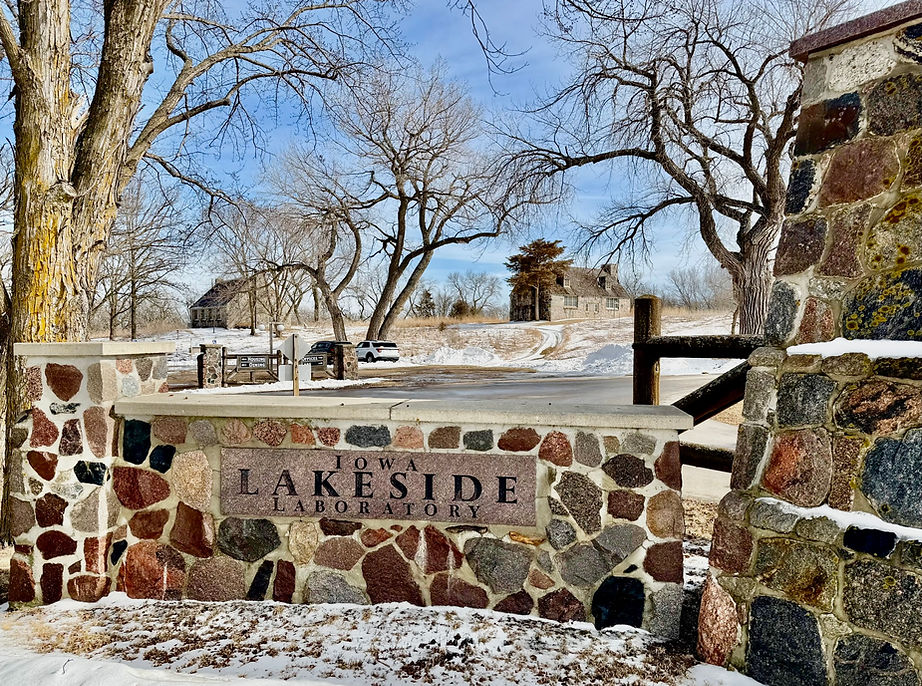
Walking among the buildings of Iowa Lakeside Laboratory in northwestern Iowa, facilities manager Matt Fairchild recalls a moment from 2014, when his father helped him move into his on-site residence. “He dropped the box he was carrying, looked out the window, and said, ‘All I see is work to do,’” Fairchild remembers. “He told me to approach it like eating an elephant—one bite at a time.”
The work his father referred to was the ongoing effort to maintain the historical integrity of an Iowa institution that was founded in 1909—a daunting task, given the scale and layout of what has grown into a 147-acre lakeside campus dedicated to education, research, and conservation.

View of West Okoboji from the Iowa Lakeside Laboratory
Glacial Origins
Just behind Fairchild, a spring symphony is warming up. It’s mid-March, and the honks of Canada and snow geese fill the air. They gather where ice meets water, and dip their heads in for a meal. Just overhead, greater white-fronted geese fly in a ragged V-formation, eyeing a spot to land and join the chorus.
Sprawling to the east of Iowa Lakeside Laboratory lies one of Iowa’s most unique geological features: West Okoboji, the state’s deepest glacial lake. Perhaps the most iconic of the Iowa Great Lakes, it sits at the western edge of a contiguous chain that connects it to Upper Gar, Minnewashta, Lower Gar, East Okoboji, and Spirit lakes.

More Iowa Great Lakes
Little Spirit, Grover’s, Diamond, East and West Hottes, Marble, Little Swan, Welsh, Horseshoe, Center, Pleasant, Lily, Prairie, Silver, and others. There are also many sloughs, marshes, and wetlands scattered throughout the area.
The story of the Iowa Great Lakes region began more than 18,000 years ago during the Wisconsin Glaciation. During the last major ice age, a tongue of the Laurentide Ice Sheet, known as the Des Moines Lobe, surged southward out of Canada into the Midwest. As the climate warmed during the glacier’s retreat, it didn’t melt away evenly. It fractured and stagnated, creating a rugged landscape of hills, marshes, and lakes that define the area today.
Once the ice began to melt, the landscape changed dramatically. At first, the cool, wet climate supported forests of spruce and larch similar to those found in northern Canada today. As temperatures warmed and conditions grew drier, those forests retreated. Lake levels dropped significantly. The rich moraine left by glacial deposits helped create tallgrass prairie and oak savanna, along with some of the region’s most fertile soils. It wasn’t long before the area’s plants, animals, and eventually people were drawn to this abundance.

The Des Moines Lobe of the Laurentide Ice Sheet once reached across the Iowa Great Lakes area
April S. Dalton, Chris R. Stokes, Christine L. Batchelor, CC BY 4.0
Indigenous Heritage
The region has a deep Indigenous history spanning thousands of years. After the Des Moines Lobe receded, the area transitioned through several distinct archaeological traditions.
First, there were the Great Oasis peoples (c. 900–1100 CE), one of the earliest farming traditions in the area. They lived in timber-frame houses and cultivated corn. Great Oasis sites have been excavated near Spirit Lake and along the Big Sioux and Little Sioux Rivers.
Next came the Mill Creek peoples (c. 1100–1250 CE), known for villages along the Little Sioux River and its tributaries. Mill Creek people were also skilled farmers who grew corn, beans, squash, and sunflowers, and hunted bison and other game. Their material culture reflects trade with broader Mississippian traditions like Cahokia.
Then the Oneota peoples (c. 1200–1700 CE) followed. Oneota was a name coined by Iowa’s first state archaeologist, Charles Reuben Keyes. The term represented the Upper Midwest tradition associated with the ancestors of the Ioway (Báxoje), Otoe, and Missouria tribes. Oneota sites are found along major river corridors in Northwestern Iowa, and they were also known for a mixture of farming, hunting, and gathering.
Beginning in the 18th century, Dakota groups, including the Wahpekute and Sisseton, were an important presence in northern Iowa and the surrounding area. Their expansion and influence were shaped by trade, pressure from other Native nations, and pressure from Europeans. Over time, these pressures contributed to the displacement of the Ioway and Otoe toward the Des Moines and Missouri river regions.

Inkpaduta

Abbie Gardner-Sharp
Tragedy at Spirit Lake
The first European people to arrive with the intention of living permanently in the area were the Gardner and Luce families, who arrived in 1856. They built log cabins on the south shore of West Okoboji near what is now Arnolds Park.
Conflict between these settlers and a band of Wahpekute Sioux led by Inkpaduta ended in tragedy in 1857. After a series of hardships—including the murder of his brother by a white liquor dealer, tensions with local traders, and one of the harshest winters on record—Inkpaduta led his band in raids on scattered frontier settlements near Spirit Lake and the Okoboji area. The attacks left scores of settlers dead, and several young women, including Abbie Gardner, were taken captive. Abbie was later released and wrote a memoir about her ordeal.
The arrival of permanent Euro‑American settlement came at a costly price to the Indigenous peoples who lived in or near the area, bringing loss of land, continued violence, and forced displacement.
_JPEG.jpeg)
Iowa Lakeside Laboratory
By 1900, University of Iowa professor (and later president) Thomas H. Macbride had made several expeditions to the region to study its distinctive geology and flora. He recognized its potential as a place to teach Iowans about the state’s natural history and the richness of its lake, forest, and prairie ecosystems. Macbride helped secure an initial five-acre tract along the west shore of Millers Bay. With fellow University of Iowa professors Samuel Calvin and Bohumil Shimek, he helped develop early field-based coursework in botany, ecology, geology, and zoology. The program opened with an initial class of 26 students, both men and women. Since then, Iowa Lakeside Laboratory has continued to offer a wide range of coursework for aspiring scientists, writers, artists, and historians.
Today, the Lab is led by executive director Mary Skopec and hosts far more than teaching facilities. It’s a cooperative hub used by the Iowa Board of Regents Universities (U of I, ISU, UNI) and state agencies like the State Hygienic Laboratory and the Iowa Department of Natural Resources (DNR). But in the early 1990s, the site nearly vanished. Facing budget cuts and sagging summer enrollment, the Iowa Board of Regents tasked a committee with reviewing operations. The group recommended the closure and possible sale of the property. Perched on prime West Okoboji Lake shoreline, the proposal sparked fears that private developers would snap it up for luxury homes, erasing a century of ecological research and public access.
The threat sparked immediate backlash from locals, alumni, and scientists nationwide. Under leadership from The Okoboji Foundation and local activists, they formed their own task force to lobby the Iowa Board of Regents. The group argued that Lakeside Lab served as a living museum of Iowa's natural history and was essential for monitoring water quality across the Iowa Great Lakes.
Instead of selling, the Iowa Board of Regents agreed to a compromise that restructured Lakeside Lab into its modern form. In 1994, the Friends of Lakeside Lab organized as a nonprofit to handle fundraising and outreach, freeing the state from sole financial responsibility. This near-death experience spurred the construction of the Waitt Building in 1998, signaling a long-term commitment. Today, the Lab stands more secure than ever, with a $6 million Innovation and Discovery Laboratory under construction.

Spring thaw at Garlock Slough Wildlife Management Area
Research Efforts
Among the Lab's most vital research efforts is the Cooperative Lakes Area Monitoring Project (CLAMP). Run by Lakeside Lab, the State Hygienic Laboratory, and volunteers, it has sampled water in the Iowa Great Lakes region for nearly three decades. Their unique long-term dataset reveals trends beyond yearly weather fluctuations. CLAMP has been crucial for tracking zebra mussels (Dreissena polymorpha), observing how they initially clear the water by eating plankton, but eventually alter the food web, hurting native fish populations.
Another key effort, the Iowa Great Lakes Hydrology Study (2021–2024), established a comprehensive water budget for the region. It clarified how nutrient pollution—specifically nitrates and phosphorus—reaches the lakes via groundwater and surface pathways. Researchers built more accurate hydrologic models to guide future conservation and restoration.
Other studies target ecosystem balance. The DNR and local associations like East Okoboji Lakes Improvement Board have sponsored extensive studies on invasives such as curly-leaf pondweed (Potamogeton crispus) and Eurasian watermilfoil (Myriophyllum spicatum). Research has shown a strong correlation between winter snow cover and spring pondweed growth. Winters with little snow allow sunlight to penetrate the ice, leading to massive pondweed blooms in spring. When these weeds die in mid-summer, they release a "pulse" of phosphorus that can trigger severe algal blooms.

Kim Hawkins and Andrew Carlson at Spirit Lake Fish Hatchery
Spirit Lake Fish Hatchery
Spirit Lake Fish Hatchery has also shaped modern Iowa Great Lakes conservation. Nestled on the isthmus between Spirit Lake and East Okoboji Lake, it dates to the early 1900s.
Research has shown that removing invasive common carp can boost water clarity in shallow water bodies like Center Lake. These bottom-feeders stir sediment, release nutrients, and uproot native plants. DNR fisheries biologist Andrew Carlson notes a key hurdle in their control: “We don't know very much about where the fish spend their time, or where we can most efficiently harvest these nuisance fish in the Ingham and High Lake complex in Emmet County.” The DNR Fisheries Research and Management teams plan to track movement via implanted transmitters to target optimal removal zones.
Every spring, under the supervision of hatchery manager Kim Hawkins, biologists harvest walleye and other species from the lakes to spawn them in the hatchery. Most walleye stocked statewide descend from the Spirit Lake and Okoboji broodstock—genetically distinct and well-suited to natural lakes. That effectively makes the hatchery an important resource for fishing in Iowa. Because natural lakes like Spirit and Okoboji are the only places in Iowa where muskellunge, northern pike, and walleye can be consistently harvested for broodstock, this facility supplies the fry (or baby fish) of these species for the entire state and beyond. The process takes manpower, teamwork, and expertise.
Due to the spread of invasives, the hatchery has also had to adapt and modernize its practices. Historically, hatchery equipment pumped water directly from Spirit Lake to incubate the eggs they harvested. With the arrival of zebra mussels, this became problematic. Zebra mussel larvae are microscopic, and they couldn't risk accidentally pumping the larvae into the hatchery and stocking them in other Iowa lakes. The hatchery installed a recirculating aquaculture system using treated, temperature-controlled, and recycled water. This creates a biosecure environment, ensuring that when they stock walleye into a lake elsewhere, they aren't accidentally stocking zebra mussels too. In the end, the investment of time and resources is worth it to all who use the lakes—even the non-human ones.
Thanks to monitoring technology, Hawkins described an unexpected discovery: “We stock muskies in the spring. We ended up finding out, because of radio telemetry on a certain number of those fish, that they were disappearing. We wondered, where are the muskies going? It turns out we were releasing muskies next to a boat ramp not far from a blue heron rookery on the Minnesota side of the region. The water quality here in the spring is so lovely, you can see down to the bottom, but the birds could also see down to the bottom. The herons were loving our muskies.” Hawkins added that staff responded by stocking larger fish later in the season and dispersing them widely to evade heron predation.

Matt Fairchild at Iowa Lakeside Laboratory
Ongoing Conservation
The advice Matt Fairchild received from his father echoes in the conservation work that continues across the region. There is much more work to do, but every action taken is another bite out of the elephant. Another example of conservation action can be found in the Lake Restoration Plan for Silver Lake, thirteen miles west of the main chain. There, high phosphorus concentrations in the lake have fueled algal blooms, which limit light penetration into the water column. Wind, waves, and boating activities can also disturb bottom sediment, further limiting light penetration. The restoration plan includes aquatic vegetation management, involving native plant species such as coontail (Ceratophyllum demersum), sago pondweed (Stuckenia pectinata), and wild water celery (Vallisneria americana). These plants are extremely beneficial to a lake’s ecosystem by helping stabilize bottom sediment, providing habitat for fish, and capturing nutrients that might otherwise result in bacteria and algal growth.
Join the Effort
Readers can help these important efforts. Organizations like the Okoboji Protective Association (OPA) offer volunteer opportunities to help preserve and enhance the ecological health of the Iowa Great Lakes Watershed. Since its founding in 1905, the OPA has led a range of impactful initiatives, including helping write Iowa’s early fish and game laws; drafting initial legislation to monitor and prevent the spread of invasive species; initiating the first watershed study of the lakes; partnering with the Iowa DNR to support wetland restoration; and helping establish the Dickinson County Clean Water Alliance. OPA supports CLAMP and encourages volunteers who care about clean water to help by collecting and processing water samples.
Migratory species observed during our 4-Day Visit


Other species seen: bald eagle, red-tailed hawk, osprey, great blue heron, ring-necked pheasant, Canada goose, northern pintail, trumpeter swan, wood duck, mallard, gadwall, lesser scaup, American wigeon, ring-billed gull, and many more.
Spring Migration
Water quality matters to the animals who visit here. The impact of these diverse conservation initiatives is visible in the number of migratory birds that pass through the region each spring. The Iowa Great Lakes are a critical stopover point within the Mississippi Flyway. Hundreds of species move through or arrive to breed each spring. Over 25 species of ducks and geese, like northern pintails, canvasbacks, and blue-winged teal, can be found. Numerous species of shorebirds like American golden-plovers, pectoral sandpipers, and yellowlegs also move through. Dozens of species of songbirds, including warblers, vireos, thrushes, and flycatchers, join them. Together, they create a seasonal chorus that signals the health and vitality of these waters.
According to BirdCast (a project by the Cornell Lab of Ornithology), between 10 and 30 million birds may cross the state during spring migration. It’s common to see thousands of individual waterfowl on the Iowa Great Lakes in March and April. Flocks of American white pelicans in the hundreds and snow geese in the tens of thousands are hallmark sights of the spring season.
This wave of birds follows a relatively predictable schedule. From late February through March, visitors will see the early birds like geese, mallards, pintails, and small numbers of sandhill cranes. April brings more variety, like pelicans, cormorants, loons, and early shorebirds. In May, neotropical migrants who spend the winter in Central and South America, like warblers, orioles, hummingbirds, and tanagers, return to the area.
If readers want to see these numbers firsthand, some of the best spots near the lakes include the Kettleson Hogsback Wildlife Management Area, known for one of the region's highest species counts. Trumbull Lake and Barringer Slough, south of the lakes, are hotspots for large waterfowl and shorebird concentrations. Dugout Creek, west of the lakes, is another excellent location for seeing secretive marsh birds like rails and bitterns. Real-time sightings can be found on eBird’s "Hotspot" map for Dickinson County, where local birders post daily tallies showing which species have arrived in the past 24 hours.

Kettleson Hogsback Wildlife Management Area

Trumpeter swans on West Hottes Lake
Protecting a Precious Landscape
Established by glaciers and shaped by time, the Iowa Great Lakes region is one of the state’s most remarkable landscapes. For thousands of years, people have stewarded this land. While many continue to do so today, protecting this living history for future generations is a responsibility that rests with all of us.
Works Cited
Carlson, Andrew. Personal Interview. 17 Mar. 2026.
Fairchild, Matt. Personal Interview. 18 Mar. 2026.
Gardner‑Sharp, Abbie entry. Biographical Dictionary of Iowa, State Historical Society of Iowa, https://uipress.lib.uiowa.edu/bdi. Accessed 11 Apr. 2026.
“Great Oasis.” University of Iowa Museum of Natural History, https://mnh.uiowa.edu/great-oasis. Accessed 11 Apr. 2026.
Hawkins, Kim. Personal Interview. 17 Mar. 2026.
Keyes, Charles R. "Prehistoric Man in Iowa." The Palimpsest, Sept. 1927.
Office of the State Archaeologist, University of Iowa. “Great Oasis Culture.” Explore Iowa Geology, University of Iowa, https://www.exploreiowageology.org/assets/text/GeoArch/4Great%20Oasis-4.pdf. Accessed 11 Apr. 2026.
Office of the State Archaeologist, University of Iowa. “The Mill Creek Culture.” Iowa Pathways, Iowa PBS, https://www.iowapbs.org/iowapathways/mypath/2548/mill-creek-culture. Accessed 11 Apr. 2026.
“Spirit Lake Massacre.” Teaching Iowa History, https://www.teachingiowahistory.org/iowa-stories/spirit-lake-massacre. Accessed 11 Apr. 2026.
Zieglowsky, Debbie J. "Thomas Macbride's Dream: Iowa Lakeside Laboratory." Palimpsest, Mar. 1985.