.jpg)
“Evolutionary law determines what is essential. No frivolous feature
or unnecessary task is perpetuated in a bird’s life.”
—Maryjo Koch, Bird Egg Feather Nest
Our patio sits on the south side of the house. Weeds persist in the cement cracks, but I don't much care. Weeds are a haven for living things, and living things I do appreciate, regardless of how many legs they have. Just off the patio and alongside the house, a wire fence runs six feet up and four feet across. A trumpet vine climbs up its rungs and produces slender and erect orange flowers that cluster like the Queen’s Guard. The vine needs a taller fence, but I like the canopy it creates as it lops over the walk.
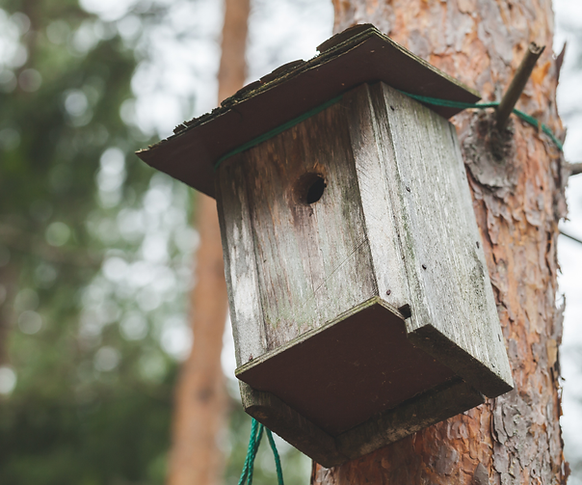
Two birdhouses hang from the fence, and the foliage from the trumpet vine creates a camouflage effect. The first house mimics a red barn, faded from years of wear. Sturdy in construction, it has a single hole for a door and an antique porcelain insulator for a perch. The other is a flimsy white house with a curling roof. Its perch fell off, but the tiny nails that held it are still there. It weighs less than half of the other. If the red barn is a single-family bungalow, the white house is something akin to a drafty tent in a windstorm, but for some reason, this year’s house wrens preferred it.
The birdhouses on our fence are popular wren nesting sites. In the spring and midsummer, the males dart about, preparing several nests for potential mates. They line what may be up to a dozen nests with a base of twigs and wait for their hopeful mates to pick a favorite. The males know the ladies are unpredictable, so they select houses of all kinds: sturdy or flimsy, drafty or cozy, empty or already inhabited by chickadees or bluebirds, ready-made birdhouses, abandoned shoes, cow skulls, watering cans, mailboxes, and any other such container seemingly fit for a queen.
.png)
The females choose their spots and set about the finishing touches. They gather softer stuff—animal hair, grass, weeds, bits of paper, feathers, and, luck be had, a bit of dryer lint. They top off their abodes with spider egg sacks, a natural cleaning agent, for when the spider hatchlings emerge, they eat common nest parasites like mites and fleas. The spiders get an easy meal, while the birds get a free house cleaning.
Though they weigh no more than five dimes, house wrens are the fiercest birds in our neighborhood, bullying others out of their nests and scolding predators from low perches. While I’m reading or watering the petunias, I receive a daily lecture on the patio.
Most years, I try not to become emotionally attached to the wrens. We have three outdoor cats who are fatly fed but still enjoy a romp with something feathered now and again—well, two of the three cats, at least. Rice, not so much. He’s nearly died several times: trapped for five days in a utility trailer, shot by the neighbor, coon fight, festering cyst. He’s now retired from a life of peril. Rice’s idea of exercise is hefting his substantial girth up onto the patio chair so he can while away the afternoon hours.

The most recent wren couple that took up residence in the white house endeared themselves to me, at least for a time. As I sat on the patio, the pair chittered about, restless, busy, showing off for one another by hopping among the trumpet vines and flitting here and there on the birch tree above. Their barred plumage was just visible in the dark of the foliage, tails giving them away, pushing downward with every trill and scold. We became familiar to the point where they didn’t much mind my movements in and out of the patio door, just kept about their bird lives, eating insects and singing songs. I nearly named them.
Before long, five brown speckled eggs rested in the nest. Tiny spiders crawled about, sprucing up the place in anticipation while the mother incubated the eggs. Now and again, she left the nest to feed. All the while, the male watched over the place from the low boughs of the birch tree.
In a nearby silver maple, a pair of Baltimore orioles rustled in a bag-shaped nest and prepared for hatchlings as well. Their orange and black feathers were unmistakable and caused quite a stir. My husband and I called each other to the windows with every sighting. We hoped the mulberries and crab apples would keep them coming back year after year, but placed orange halves and jelly on the patio just to be sure.
The wren clutch hatched without my knowing—perhaps emerged in the night while bats flitted about in search of moths and mosquitoes or in the early morning hours while the sun broke over the horizon.

The couple took turns during an exhaustive schedule of feedings, reminiscent of my trials with four infant boys. My husband and I were bleary-eyed and sleep-deprived for a solid four years. While we were something akin to the walking dead, the wrens worked like automatons, snatching green worms and spiders, ants and beetles, and all this while remaining bright-eyed and upright.
House wren fledglings are fed for thirteen days before it’s time to leave the nest. I knew how tired the parents must have been and silently cheered them on. You can do this. Twelve more days, eleven more days, ten, nine, eight, seven, six . . .
Complex communicators, the pair called to each other from the low branches with chits and cranks, scolds and coos, trills and rips. They were prone to dramatic shifts in mood with the slightest provocation—doting or distant, patient or snappish; they changed with the tides. Only large songbirds dared to nest near them, for the male wrens ruled the undergrowth and destroyed the eggs of other birds nesting in the area by piercing them with their long, slender beaks. Feathers flew.
Adult wrens and their fledglings both weigh about the same, 9-12 grams at most. Sometimes, spoiled and kept too long in the nest, the fledglings weigh more than the parents. Other times, house wrens prematurely fledge and fall to the ground, where they are easy prey.

Perhaps the wren parents were eaten by a predator—cat or coon, possum or dog, owl or hawk. Perhaps one of them, but both? And there were no signs of feathered destruction in the yard. Perhaps they detected some disease or deformity in their young or, in their exhaustion, flew for the hills. Perhaps their parenting wires were crossed, and they misjudged the readiness of their young. Regardless, the parents disappeared.
When the time is right, the adults will hold food back to coax the young out of the nest, but these little ones were seven days at most and not fit for famine. The chicks’ cries were desperate, starved. Late on the second day, the tiny birds tumbled from the nest. Instinct told them to toddle behind the fence where the trumpet vine grew. So new to the world, barely here, their unblinking black eyes seemed nearer to death than life.
My son placed them back in the nest, then set out to build a catch for them out of a milk jug bottom and tiny bungee cords attached to the rim of the birdhouse. If they emerged again, they wouldn’t fall more than six inches, and the cats couldn’t get to them. I checked the catch numerous times, but their adventure was over; the birds were quieting down. Should I feed them? I wondered. When I was eight, I had attempted to keep three baby raccoons alive and succeeded for two days before I found them stiff and slack-jawed in their box. No. If the wrens weren’t going to bring them the stuff of life, I wasn’t going to either.
By morning, there were no more cries, and I was afraid to look inside the nest.
.png)
The house wren, Troglodytes aedon, is named after the Queen of Thebes, who, in Greek mythology, accidentally killed her own child. Jealous of her sister-in-law’s large brood, Aedon attempted to murder her sleeping nephew but killed her own son instead as he slept in his cousin’s bed. Like greedy and misguided humans, perhaps the wrens brought about the demise of their own young while out grabbing for more. Perhaps not.
In the early 1900s, Iowa artist and ornithologist Althea Sherman’s love of the house wren switched to contempt when she watched a pair of the birds destroy the eggs of phoebes and black-billed cuckoos. Sherman began a campaign against the house wren, spreading her antipathy for the birds in scientific journals. She so hated the wren that she wrote a stipulation in her will that they not be allowed to breed on her property. While some ornithologists sympathized with Sherman’s attitude, others pointed to a broader picture. House wrens, like all wild things, are, above all, survivalists. Their methods may not always be obvious to us, but that is not to say the devil is in the deed.
Sometime mid-summer, I realized the Baltimore orioles were gone; I hadn’t seen them for weeks. I wondered if the wrens had destroyed their eggs and realized it was probably so. Right around this same time, another male wren built a nest in the red barn. It was a show nest for the time being—just a haphazard tangle of sticks—for there was no female about. Above him in the birch, a downy woodpecker searched the tree for insects and replaced the orioles in our affections.
I approached the red barn with a mind for tampering, imagined reaching in and plucking out every last stick, so when the female bird arrived for her viewing, she would turn down the unfurnished abode and choose someplace else. As the tiny male house wren burst forth with its bubbling song in a desperate desire for young, I thought better of it and went inside to fix dinner for my own.
Staci Mercado won a Midwest Book Award for her historical fiction novel, Seeking Signs (Four Feathers Press, 2013). She has published work in Hippocampus, Broad Street, Barely South Review, Flash Fiction Magazine, Fiction Southeast, Canary, and Litro. She is the founder of Iowa Natives.